



LG Kavinder inaugurates Automated Driving Test Centre, Automated Testing Station at Phyang.
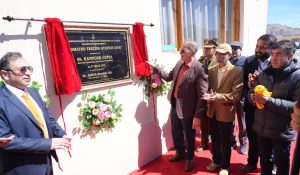
LG Kavinder inaugurates Automated Driving Test Centre, Automated Testing Station at Phyang.
Says new facilities will strengthen road safety and transparency in transportation systems
Says modern technology essential for vehicle inspections
Says advanced technology will improve driving skill assessment.
Leh, March 5: The Hon’ble Lieutenant Governor of the Union Territory of Ladakh, Shri Kavinder Gupta, emphasised the importance of vehicle fitness and responsible driving in ensuring road safety and environmental protection. He remarked that just as human beings require regular health check-ups to remain fit, vehicles also require periodic fitness checks to ensure they are safe to operate and do not contribute to environmental pollution.
The Lt Governor was speaking at the inauguration of the state-of-the-art Automated Driving Test Centre (ADTC) and Automated Testing Station (ATS) at Phyang. The facilities mark a significant step towards improving road safety, transparency and efficiency in vehicle and driver testing in the Union Territory.
The Automated Driving Test Centre has been established at an estimated cost of Rs 2.10 crore under the Special Development Package (SDP) and is expected to modernise the process of assessing driving skills and vehicle fitness in Ladakh.
Among those present on the occasion were Chief Secretary Ashish Kundra, Director General of Police Mukesh Singh, Administrative Secretaries Rahul Singh and Baseer-ul-Haq, Deputy Commissioner Leh Romil Singh Donk, Regional Transport Officer Ladakh Sonam Nurboo, and other senior officials from the Transport Department and RTO Ladakh.
Addressing the gathering, the Lt Governor noted that with the rapid advancement of automotive technology and the increasing complexity of vehicles, traditional manual testing methods are becoming inefficient and time-consuming. He said that manual processes are often prone to human error, whereas Automated Testing Stations leverage modern technology to conduct accurate and efficient vehicle inspections.
Speaking about the Automated Driving Test Centre, the Lt Governor said that such facilities play an important role in enhancing road safety by using sensor-based technology, cameras and advanced monitoring systems to evaluate driving skills without human intervention. The automated process ensures faster testing and quicker results, reducing waiting time for applicants.
He said the inauguration of these facilities marks an important milestone in Ladakh’s efforts to strengthen road safety, improve transparency in the issuance of driving licences and vehicle fitness certification, and promote environmentally responsible transportation systems.
The Lt Governor added that the UT Administration of Ladakh is committed to making the process of applying for motor vehicle fitness certification and driving tests more transparent, online and hassle-free for the public. He also informed that similar infrastructure would soon be developed in Kargil district to extend the benefits of automated testing to people across Ladakh.
During the event, a representative of WAPCOS Limited, the implementing agency for the Automated Testing Station, informed that the Voluntary Vehicle-Fleet Modernization Program (V-VMP) launched by the Ministry of Road Transport and Highways (MoRTH) aims to phase out unfit and polluting vehicles in an environmentally responsible manner. He also informed that MoRTH has mandated that from October 1, 2024, all commercial vehicles (heavy, medium, and light transport vehicles) must undergo fitness testing at registered Automated Testing Stations. This requirement aims to eliminate human intervention and ensure factual reports for vehicle fitness, with penalties for non-compliance.
The need to increase the frequency of driving tests, conduct fitness tests for heavy vehicles, and provide basic public facilities such as drinking water and toilets at the venue was also discussed during the occasion.