



Modern Science & Buddhist Philosophy Lecture by Ven. Geshe Dorji Damdul at Central Institute of Buddhist Studies (CIBS).
May 13, 2026
Modern Science & Buddhist Philosophy Lecture by Ven. Geshe Dorji Damdul at Central Institute of Buddhist Studies (CIBS).
On the fourteenth day of the Sacred Exposition of the Holy Relics of Lord Buddha in Leh, Ven. Geshe Dorji Damdul delivered an insightful lecture on Arya Nagarjuna’s Philosophy of Emptiness and Quantum Physics for Managing Emotions, highlighting the convergences and divergences between modern science and Buddhist philosophy.
The talk was organised by Flowering Dharma at Central Institute of Buddhist Studies (CIBS) in connection with the Sacred Exposition of the Holy Relics of the Tathagata.
The programme commenced with Ven. Geshe Dorji Damdul lighting the ceremonial lamp, followed by a special devotional song presented by members of Flowering Dharma as an offering to the Tathagata. The welcome address was delivered by Prof. Rajesh Ranjan, Vice Chancellor of CIBS.
During his lecture, Ven. Geshe Dorji Damdul, who serves as the Director of Tibet House, elaborated on the relationship between modern science and Buddhist philosophy, particularly in the context of emotional well-being, ethics, and the broader purpose of life. Referring to global concerns including the Sustainable Development Goals and mental well-being initiatives, he explained how both scientific inquiry and Buddhist philosophy seek to understand reality, though through different methodologies.
He highlighted key points of divergence between modern science and Buddhist philosophy, including the compartmentalisation of scientific disciplines such as physics, chemistry, biology, neuroscience and psychology, in contrast to the integrated approach of Buddhist thought. He also spoke about the Buddhist classification of phenomena into evident, slightly hidden and very hidden phenomena, questioning whether modern science may one day be able to explore concepts such as rebirth.
The lecture further explored philosophical discussions on śūnyatā (emptiness), quantum vacuum and cosmology, including reflections on the Big Bang theory. Ven. Geshe Dorji Damdul discussed the parallels between substratum emptiness and the derivative universe in Buddhist philosophy, alongside the concept of quantum vacuum and the evolving universe in modern physics.
Speaking on ontology and soteriology, he emphasised that ignorance is the root cause of human misery and suffering. Quoting Albert Einstein, he reflected on the importance of expanding compassion beyond personal attachments and connected the thought with teachings from Buddhist sutras.
He also addressed the philosophical divergence between Buddhist perspectives on existence and Charles Darwin’s theory presented in the Origin of Species.
The lecture witnessed the participation of scholars, students from various departments of CIBS, officials of the UT Administration, and representatives from Ladakh Buddhist Association (LBA) and Ladakh Gonpa Association (LGA). The session concluded with an interactive question-and-answer session with the audience, during which Ven. Geshe Dorji Damdul also congratulated Flowering Dharma for organising the programme.
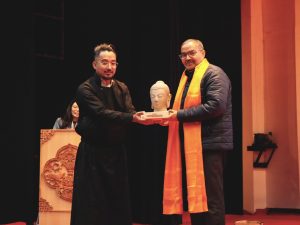
A felicitation ceremony was also held during the programme wherein Prof. Rajesh Ranjan, Vice Chancellor of Central Institute of Buddhist Studies (CIBS), presented a Thangka painting of Lord Buddha to Ven. Geshe Dorji Damdul as a mark of respect and appreciation. On behalf of the UT Administration and Flowering Dharma, Mr. Tashi Namgyal offered a memento along with traditional khataks (ceremonial scarves) to the guest speaker. In return, Ven. Geshe Dorji Damdul presented Thangka paintings to both Prof. Rajesh Ranjan and Mr. Tashi Namgyal. Prof. Rajesh Ranjan was also felicitated with a memento by Flowering Dharma. The programme concluded with a vote of thanks delivered by Ms. Lobzang.