



LAAC&L Kargil Observes Partition Horrors Remembrance Day with Silent March, Photo Exhibition and Theatrical Performance.
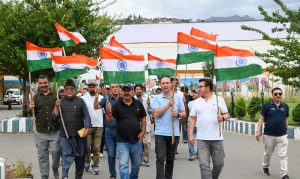
LAAC&L Kargil Observes Partition Horrors Remembrance Day with Silent March, Photo Exhibition and Theatrical Performance.
Kargil, August 14, 2026: Under the aegis of the Department of Tourism & Culture, UT of Ladakh, the Ladakh Academy of Art, Culture and Languages (LAAC&L), Kargil, today organised a solemn programme at the Tourist Facilitation Centre (TFC) Amphitheatre, Biamathang, to observe Partition Horrors Remembrance Day.
The programme was organised to remember the immense human suffering, loss of lives, displacement and disruption of families and communities caused by the Partition of India in 1947, and to preserve the memories and lived experiences associated with the period.
The programme commenced with a two-minute silence in memory of those who lost their lives and suffered during Partition, followed by a Silent March symbolising collective remembrance of the pain, displacement and hardships endured by millions of people during the upheaval of 1947.
A photo exhibition on the Partition of India was also organised as part of the observance. The exhibition featured photographs and visual documentation depicting the mass displacement, migration, separation of families, refugee journeys and the difficult circumstances faced by people in the aftermath of Partition. The exhibition provided an opportunity for visitors, particularly the younger generation, to engage with the historical events and understand the human consequences of the division of the country.
Additional District Development Commissioner (ADDC), Kargil, Ghulam Mohammad was the Chief Guest, while Councillor Abdul Hadi attended the programme as the Guest of Honour. The event was also attended by local poets, writers, scholars, artists, theatre practitioners and members of the general public.
Speaking on the occasion, noted writer and scholar Muhammad Sadiq Hardassi highlighted the impact and legacy of the Partition of 1947 in the context of Ladakh, with particular reference to its historical and socio-cultural implications for the region.
Master Jaffer Ali spoke on the wider impact of Partition across India, reflecting on the loss of lives, displacement, disruption of communities and the enduring social and emotional consequences of the tragedy.
A poignant theatrical performance on Partition was presented by the Ranthak Theatre Group, portraying the experiences of displacement, uncertainty, separation and human suffering associated with the events of 1947. The performance provided an artistic expression of the human dimension of Partition and encouraged reflection on the consequences of division, hatred and violence.
The programme concluded with a message to remember the painful experiences of Partition with sensitivity and dignity and to draw lessons from history for strengthening peace, unity, social harmony and mutual understanding. The observance underscored the importance of preserving the memories and lived experiences of those affected by Partition and sensitising future generations to the human cost of division and violence.
The observance of Partition Horrors Remembrance Day reaffirmed the collective resolve to remember the suffering of those affected by the Partition of 1947 and to promote harmony, human values and peaceful coexistence.