



NCST reviews Implementation of Constitutional Safeguards and Tribal Welfare Schemes in Ladakh.
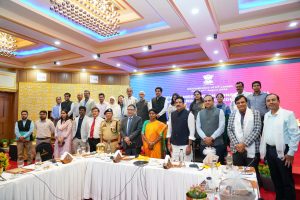
NCST reviews Implementation of Constitutional Safeguards and Tribal Welfare Schemes in Ladakh.
Leh, August 31, 2026: A review meeting between the National Commission for Scheduled Tribes (NCST) and the UT Administration of Ladakh was held today at Hotel Zen, Leh to review the implementation of constitutional safeguards, welfare schemes and development programmes for the Scheduled Tribe (ST) population of the Union Territory.
The meeting was chaired by Dr. Asha Lakra and Shri Jatothu Hussain, Hon’ble Members of the National Commission for Scheduled Tribes, in the presence of Secretary, NCST, Sh Prashant Kunar Singh; Chief Secretary, UT Ladakh, Ashish Kundra. DGP, Ladakh and Administrative Secretaries of the UT Administration participated in the meeting.
At the outset, Secretary, Social and Tribal Affairs, Nidhi Malik, made a detailed presentation on the ST population profile of Ladakh, including its demographic and socio-economic aspects, and briefed the Commission on various schemes and programmes being implemented for tribal welfare. The presentation covered the National Scholarship Portal and scholarship schemes for ST students, Pradhan Mantri Adarsh Gram Yojana (PMAAG), Dharti Aaba Janjatiya Utkarsh Abhiyan (DAJUA), Jal Jeevan Mission, PMAY-G, Ayushman Bharat and other major welfare and development interventions.
The Commission reviewed the status of tribal hostels, educational facilities, livelihood programmes, Self-Help Groups, skill development initiatives, healthcare facilities and infrastructure in tribal and remote areas. Dr. Lakra sought details regarding domicile criteria, identification of villages under targeted tribal development programmes, hostel locations, scholarship and stipend coverage, student dropouts and measures being taken to facilitate higher education for ST students.
Secretary, School Education, Bhanu Prabha, briefed the Commission on the status of schools and hostel facilities across Ladakh. The Commission also reviewed the implementation of the National Education Policy, incorporation of local languages and dialects in the curriculum, preservation of local stories and traditions, and development of region-specific educational content suited to the geographical and cultural conditions of Ladakh.
Healthcare and social security in remote tribal areas also came under detailed review. The Commission sought information regarding empanelled government and private hospitals, availability of healthcare services in remote areas and measures for safeguarding the health of herders and pastoral communities exposed to extreme climatic conditions.
The Commission further reviewed livelihood promotion through SHGs, skill development, access to credit, marketing and market linkages for traditional products and local enterprises. The need to strengthen SHGs, promote local products and cuisine, support traditional crafts and improve branding and marketing mechanisms was emphasised.
Chief Secretary Ashish Kundra apprised the Commission of the Administration’s efforts towards strengthening traditional livelihoods, particularly pashmina spinning and weaving, and improving support to producers. He informed that focused interventions are also being undertaken for nomadic communities under the Vibrant Villages Programme, including provision of basic infrastructure and housing support in remote areas.
The Chief Secretary highlighted initiatives relating to climate-resilient agriculture, greenhouse cultivation, winter vegetables, apricot-based livelihoods, Farmer Producer Organisations and cold-chain infrastructure. He also informed the Commission about Sidco loans, recent loan melas organised in coordination with banks and stakeholders to facilitate credit and entrepreneurship opportunities.
Power and water infrastructure in remote areas were also reviewed. The Administration apprised the Commission about grid connectivity, transmission coverage and decentralised solar power solutions. Water scarcity, implementation of the Jal Jeevan Mission and the need for suitable water conservation measures, including check dams, particularly in areas such as Nubra, were discussed.
The Commission also reviewed issues relating to wildlife demarcation and tribal rights. The Administration informed that the process of defining and verifying wildlife boundaries through geographical coordinates and field-level verification is underway.
Issues concerning women’s safety, domestic violence, women police personnel, recruitment and deployment, cyber awareness and drug-related cases among youth were also discussed. The Commission emphasised the need for stronger awareness, preventive measures and effective implementation of welfare and protection programmes.
The meeting also discussed healthcare manpower and emergency air connectivity in remote areas. The Administration informed the Commission that efforts are being made to provide specialist medical services in remote locations, while acknowledging the challenges of retaining specialists in harsh winter conditions. The status of emergency and air-evacuation facilities in Kargil and Nubra was also reviewed, with the Administration stating that coordination with the Indian Army and Airports Authority of India is being maintained.
The Commission emphasised effective implementation and regular monitoring of constitutional safeguards, reservation provisions and welfare schemes for ST communities. It stressed the need for inter-departmental convergence and focused interventions to ensure that the benefits of government programmes reach tribal communities, particularly those living in remote, high-altitude and border areas.
The meeting was attended by Shri Prashant Kumar Singh, Secretary, NCST; Shri Purnendu Kant, Director, NCST; Shri Manohar N. Sukole, Deputy Secretary, NCST; Ms. Sonal Rai, Senior Investigator, NCST; Ms. Riya and other senior officers and concerned officials of the UT Administration and the National Commission for Scheduled Tribes.