



On Sewa Diwas, L-G VK Saxena dedicates world’s highest-altitude twin flower fields in Leh to people.
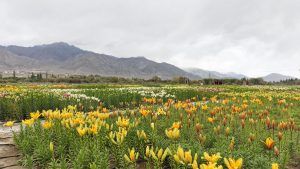
On Sewa Diwas, L-G VK Saxena dedicates world’s highest-altitude twin flower fields in Leh to people.
With over 24 lakh Lilium and 1 lakh Gladiolus planted over 40 acres, the flower fields will create alternative livelihoods for farmers through floriculture.
Guided by Hon’ble PM’s vision, this facility would promote agricultural diversification, enhance farmer incomes and strengthen local economy through floriculture
Leh, September 17: Lieutenant Governor, Shri Vinai Kumar Saxena, today inaugurated the world’s highest-altitude twin flower fields in Leh, to mark the 76th birth anniversary of Hon’ble Prime Minister, Shri Narendra Modi. Besides being the highest in the world, the two flower fields at Choglamsar and Stakna in Leh, at an altitude of 10,600 feet, are also the highest and the largest flower fields in the country. With over 25 lakh high-value flowers – including 24 lakh Lilium and 1 lakh Gladiolus, the flower fields spread over 40 acres. This is the first experiment of this size and nature at high-altitude in Leh, and its successful execution has further paved the way for replicating this model in other parts of Ladakh.
The development of the twin flower fields marks a significant milestone in promoting agricultural diversification, farmers’ empowerment and creating new livelihood opportunities through commercial floriculture in Ladakh, as envisaged by the Hon’ble Prime Minister.
Interestingly, the flower field at Choglamsar has been developed in a record time of just two months. Plantation at Choglamsar began on 16th July, and the first bloom started in the first week of September. On the other hand, plantation of nearly 14 lakh Liliums at Stakna flower field began in August, and the first bloom is expected around the end of October.
The project seeks to leverage Ladakh’s unique climatic conditions and the growing national and international market potential of high-value flowers to create a new avenue for income generation, entrepreneurship and rural economic development. As per market rates, Lilium sells at a premium of Rs 60-70 per stick in wholesale markets, while the retail sale of Liliums fetches an even higher price.
The Choglamsar flower park will serve as a demonstration and model floriculture centre, where high-value flowers such as Lilium, Gladiolus, Tulips and other ornamental species, with strong market demand in national and international markets, will be cultivated.
It will thus create a new, sustainable source of income for Ladakh’s farming community through self-help groups and cooperatives. Under the project, the Agriculture Department in the first year will develop the flower field and, at the time of bloom, transfer it to the selected Self-Help Groups (SHGs) and cooperative societies. The department will handhold the SHGs and the cooperatives in marketing flowers in national and international markets to maximise returns. Subsequently, from the next year, the cooperatives will themselves undertake commercial cultivation, harvesting and value addition of the Lilium flowers.
For this, local farmers are being given structured training in scientific floriculture, modern cultivation practices, and establishing floriculture as a viable commercial enterprise.
Inaugurating the Flower Garden, the Lieutenant Governor said the initiative is more than just the start of flower cultivation; it is an effort to sow the seeds of new livelihoods, skills, and opportunities for the people of Ladakh. A key objective of the Flower Garden is to develop it as a training and demonstration centre for farmers and youth. The facility will provide exposure to modern cultivation techniques, scientific farming practices and improved post-harvest management, enabling farmers to acquire the knowledge and skills required to take up floriculture at the farm and village level.
Besides functioning as a recreational and educational space for residents and tourists, the flower fields will create an ecosystem where not only flowers, but also knowledge, skills and enterprises can grow. Floriculture is a high-value agricultural activity that can complement traditional farming, enhance farmers’ incomes and open new avenues for employment and entrepreneurship,” L-G Shri Saxena said.
The Flower Garden will be opened to the general public from September 18, 2026. To ensure its proper maintenance and upkeep, a nominal entry fee of ₹25 for adults and ₹10 for children has been fixed. The revenue generated will be utilised for the maintenance and upkeep of the Garden.