



Chief Secretary calls for Targeted Development Interventions in Tribal Areas under DAJGUA.
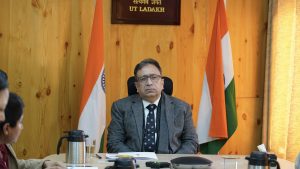
Chief Secretary calls for Targeted Development Interventions in Tribal Areas under DAJGUA.
Leh, November 5, 2026: Chief Secretary, Union Territory of Ladakh, Ashish Kundra, today chaired a meeting to discuss and consider projects proposed under the Dharti Aaba Janjatiya Gram Utkarsh Abhiyan (DAJGUA) of the Ministry of Tribal Affairs, Government of India, for implementation in the Union Territory.
The meeting reviewed the framework and implementation guidelines of the Abhiyan, including its project portfolio, coverage, mission period, key focus areas and convergence requirements. A detailed presentation was made on the implementation of the Pradhan Mantri Adi Adarsh Gram Yojana (PMAAGY) under the DAJGUA framework, works approved during the financial year 2025–26 and their progress. The departments also presented proposals for the coming period, including the construction of girls’ hostels and Tribal Multipurpose Community Halls (TMCHs), along with the improvement of infrastructure at Bal Ashrams.
The Chief Secretary examined the proposed projects and sought clarity on the criteria for selecting locations and identifying interventions. He stressed that every proposal must be supported by proper justification, reflect the needs of tribal communities and address gaps in essential infrastructure. He also directed the concerned departments to ensure that proposals adequately incorporate essential facilities such as furniture, heating arrangements, toilets and other operational requirements, wherever applicable, to make the infrastructure functional and suitable for local climatic conditions.
Emphasising equitable development across tribal areas of Ladakh, the Chief Secretary called for focused attention on strengthening healthcare facilities, including the upgradation of Primary Health Centres, Community Health Centres and district hospitals. He also underscored the importance of improving hostel infrastructure, sanitation, heating arrangements and other basic amenities to ensure better living conditions and access to essential services for tribal communities.
The Chief Secretary stressed the need to address connectivity gaps in remote and far-flung tribal villages to improve access to essential services and development opportunities. He directed the concerned departments to hold a separate meeting with the Planning Department to examine connectivity-related proposals, assess their feasibility and ensure their alignment with DAJGUA guidelines. He further emphasised that such interventions should be prioritised on the basis of local requirements and supported by proper planning and justification.
The meeting also discussed the scope for promoting sustainable livelihood opportunities for tribal communities through need-based interventions in sectors such as fisheries, responsible tourism and homestays. The Chief Secretary called upon the concerned departments to explore the potential of these sectors and formulate suitable proposals to strengthen local livelihoods, generate employment and improve the socio-economic conditions of tribal communities.
The Chief Secretary directed the departments to thoroughly examine the DAJGUA guidelines and identify eligible sectors and interventions in accordance with the prescribed framework and objectives of the Abhiyan. He emphasised that all proposals should be need-based, properly planned and aligned with the scheme’s guidelines, with priority given to addressing infrastructure gaps, strengthening basic services and promoting sustainable livelihood opportunities across tribal areas of the Union Territory.
The meeting was attended by Commissioner/Secretary, Health, Lalinthakhuma Franklin; Secretary, Social and Tribal Welfare, Nidhi Malik; Secretary, School Education, Bhanu Prabha; Director, School Education, Tsering Paldan; CPO Leh, Tsewang Gyalson; and other concerned officers and departmental representatives.