



Chief Secretary reviews Functioning of Solid Resource Management Centres across UT Ladakh, Calls for Institutional Reforms and Standardised Waste Management System.
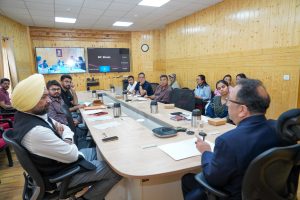
Chief Secretary reviews Functioning of Solid Resource Management Centres across UT Ladakh, Calls for Institutional Reforms and Standardised Waste Management System.
Leh, July 29, 2026: Chief Secretary of the Union Territory of Ladakh today chaired a high-level review meeting to assess the functioning, operational efficiency and future roadmap of the Solid Resource Management Centres (SRMCs) established across the urban and rural areas of the Union Territory.
The meeting focused on strengthening the solid waste management ecosystem through institutional reforms, standardisation of infrastructure, improved operational mechanisms and enhanced resource recovery.
During the meeting, the Chief Secretary conducted a comprehensive review of the existing SRMCs functioning under various departments in Leh and Kargil districts, including facilities established under the Swachh Bharat Mission (SBM), Rural Development Department (RDD), Municipal Committees and the Ladakh Renewable Energy Development Agency (LREDA). He reviewed the operational status of the SRMC in Leh and sought details regarding machinery utilisation, maintenance, operational challenges and future upgradation requirements.
Expressing concern over the underutilisation of expensive machinery in several centres, the Chief Secretary directed the concerned departments to undertake a district-wise assessment of all functional and non-functional SRMCs.
He emphasised that redundant equipment should be relocated wherever required to maximise utilisation rather than remaining idle. He further instructed that machinery procurement should be based on actual waste generation and operational requirements instead of adopting a uniform approach for every centre.
The Chief Secretary stressed the need for a standardised tendering mechanism across the Union Territory for operation and maintenance, transportation, machinery procurement, waste collection, baling equipment, compactors and other essential infrastructure. He directed that detailed estimates be prepared by rationalising capital expenditure, operational costs and Viability Gap Funding (VGF) requirements to ensure long-term sustainability of the facilities.
Reviewing the institutional framework governing the SRMCs, the Chief Secretary proposed the establishment of a uniform district-level society under the chairmanship of the respective Deputy Commissioners to oversee the management of all SRMCs. He suggested that the society should include the District Programme Officer (DPO), Block Development Officers (BDOs), representatives from line departments and other stakeholders to ensure effective coordination, transparency and accountability in operations.
The Chief Secretary directed the concerned departments to remove institutional ambiguities and establish a clear governance framework for all SRMC assets created through Government of India funding.
The meeting deliberated on the existing waste collection, segregation and recycling mechanisms. Officials from LREDA highlighted that scientific item-wise segregation significantly improves the market value of recyclable materials, facilitates efficient baling and makes it easier for recycling companies to procure segregated waste. They also informed that better segregation enhances the overall financial viability of the centres.
The Chief Secretary reviewed the current marketing arrangements for recyclable materials and sought details regarding agencies purchasing waste from SRMCs in Leh and Kargil, prevailing rates per kilogram, transportation arrangements and the final destination where recyclable waste is processed. He directed the departments to identify reliable recycling companies and entrepreneurs willing to establish waste processing and recycling units within Ladakh, thereby reducing transportation costs and creating local employment opportunities. He also stressed the need to explore partnerships with private entrepreneurs, NGOs, Corporate Social Responsibility (CSR) initiatives and recycling industries to strengthen the waste management ecosystem in the Union Territory.
Highlighting the importance of improving operational efficiency, the Chief Secretary instructed that all SRMCs should maintain digital dashboards for real-time monitoring of waste collection, segregation, processing and disposal. The dashboard should capture village-wise waste collection frequency, quantity of waste received, processing status and machinery utilisation to facilitate regular monitoring by district authorities.
The Chief Secretary also reviewed manpower deployment across SRMCs and observed that waste segregation is a labour-intensive activity requiring sustained human effort. He directed the concerned departments to assess manpower requirements and consider increasing the engagement of trained workers, particularly women, while reviewing the existing wage structure. He suggested that skilled and semi-skilled categories be appropriately recognised to ensure fair remuneration and improved service delivery.
Emphasising the need for strengthening waste collection systems in both urban and rural areas, he directed the departments to assess the adequacy of existing collection vehicles and transportation arrangements, especially in larger towns and remote villages. He instructed that collection schedules should be standardised and transportation mechanisms strengthened to ensure uninterrupted functioning of all SRMCs.
Appreciating the dedicated efforts of field staff, particularly women engaged in segregation activities at several centres, the Chief Secretary called for the introduction of a performance-based evaluation system and institutional recognition for well-performing SRMCs. He directed Deputy Commissioners to conduct regular district-level reviews, identify operational bottlenecks and ensure that Block Development Officers remain directly accountable for the effective functioning of SRMCs under their respective jurisdictions.
Reiterating that scientific solid waste management is a priority for the Union Territory, the Chief Secretary instructed all concerned departments to work in close coordination to establish a sustainable, efficient and financially viable waste management system that is capable of meeting the unique geographical and climatic challenges of Ladakh.
The meeting was attended by the Divisional Commissioner, Secretary, Rural Development Department, Deputy Commissioner Leh, Officer on Special Duty to the Chief Secretary and other senior officers, while all Deputy Commissioners participated virtually along with officials from the concerned departments.
Thanks & Regards,
Department of Information & Public Relations,
UT Ladakh