


EJM College Leh hosts Inspiring Interactive Session with Group Captain Shubhanshu Shukla.
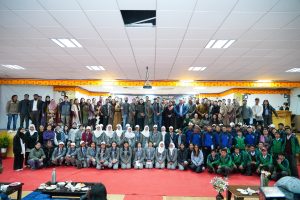
EJM College Leh hosts Inspiring Interactive Session with Group Captain Shubhanshu Shukla.
Leh, April 01, 2026: A special interactive session with renowned Indian astronaut Shri Shubhanshu Shukla, Ashok Chakra, was held today at Eliezer Joldan Memorial (EJM) College, Leh, bringing together students from various schools and colleges of both Leh and Kargil districts for an inspiring and educational engagement on space science, exploration, and future opportunities in the field.
Ms. Bhanu Prabha, IAS, Administrative Secretary, Higher Education/School Education also graced the occasion.
The programme commenced with Lighting of Lamp, followed by National Anthem.
The interactive session was organised with the objective of motivating young minds and providing students of Ladakh with a rare and valuable opportunity to directly interact with a distinguished personality from the field of space exploration. The event created immense enthusiasm among students, who attentively listened to the astronaut’s experiences, insights, and message of perseverance and ambition.
In his highly engaging address and presentation, Shri Shubhanshu Shukla shared his remarkable journey, the lessons he learned from his mission, and his experience of spending nearly 18 days in space. He spoke about the physical, mental, and scientific dimensions of life beyond Earth, while offering students a rare glimpse into the realities of human spaceflight and India’s growing role in global space exploration.
His presentation covered a wide range of fascinating topics, including India in orbit, the purpose of human space exploration, the journey beyond Earth, and the challenges of life in space. He also explained the mission cycle in detail- from countdown and launch, lift-off, and the crucial 8.5 minutes to orbit, to life in microgravity, re-entry, plasma effects, and landing systems. He discussed how astronauts adapt to the unique space environment and highlighted the importance of scientific research conducted in space, including studies related to physiology, cognition, myogenesis, microalgae, and other experiments in microgravity.
He also shared visuals and videos from his journey, including breathtaking views of India from space, which deeply fascinated the audience. Through his presentation, he demonstrated how astronauts are required to perform multiple roles, often becoming researchers, technicians, problem-solvers, and decision-makers all at once.
Speaking about India’s future in space, Shri Shukla highlighted the country’s ambitious plans, including the upcoming Indian Space Station and the long-term vision for India’s human mission to the Moon by 2040, as approved under the national space roadmap. He emphasized that this is a transformative era for India’s youth and encouraged students to remain focused and disciplined in the face of modern-day distractions.
Delivering a powerful motivational message, he told the students that the next astronaut could very well come from Ladakh. He urged them to dream big, believe in themselves, and pursue their goals with dedication, consistency, and courage. “The sky is never the limit,” he remarked, inspiring the audience to look beyond conventional boundaries and aspire for excellence.
The interactive session witnessed enthusiastic participation from students, who asked a wide range of thoughtful and curiosity-driven questions. Their queries focused on topics such as the educational path and procedure to become an astronaut, how space travel changes one’s understanding of Earth and humanity, the biggest challenges faced during astronaut training and missions, and how critical thinking, adaptability, and consistency are developed in such demanding environments.
Students also sought guidance on whether learners from humanities, chemistry, and other academic backgrounds can build a career in the space sector. Questions were raised about the role of family support, struggles and fears during training, the psychological and emotional dimensions of space travel, and the opportunities available for NCC cadets and aspiring young professionals interested in aviation, research, and space science.
Responding to the questions with warmth and clarity, Shri Shukla encouraged students to remain curious, work hard, and stay committed to lifelong learning.
The programme was attended by the Principal of EJM College, Principals of other Colleges, DIET & Schools, faculty members, dignitaries, and senior officials.
The programme was conducted by Dr. Tsetan Dolker.
Welcome speech was presented by Assistant Professor Razia Parveen.
The program concluded with vote of thanks by Dr. Sonam Wangmo.