



KREDA Organizes Awareness Programme on PM-KUSUM Scheme in Kargil.
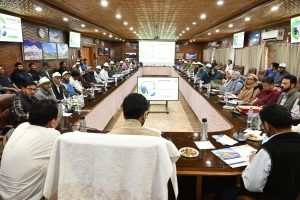
Kargil, July 22, 2026: The Kargil Renewable Energy Development Agency (KREDA), in collaboration with Oswal Pumps Pvt. Ltd., organized a highly successful Awareness Programme on the Pradhan Mantri Kisan Urja Suraksha evam Utthaan Mahabhiyan (PM-KUSUM) Scheme at the Conference Hall, Baroo. The programme witnessed an enthusiastic participation from farmers across the region.
The event was graced by the Deputy Commissioner/CEO, LAHDC Kargil, Rakesh Kumar as the Chief Guest, and the Chief Horticulture Officer as the Guest of Honour. Their esteemed presence underscored the importance of renewable energy in transforming the agricultural landscape of the region.
The programme commenced with a warm welcome address by Shri. Kacho Ahmed Khan, the Project Director/CEO, KREDA, who expressed gratitude to all the dignitaries and farmers present. In his address, he briefed the gathering about the objective of the programme, emphasizing that it was specifically conducted to create widespread awareness regarding the PM-KUSUM Scheme and its immense benefits for the farming community.
Following the welcome address, Shri. Ali Naqi, the Project Coordinator, KREDA, delivered a detailed presentation through a PowerPoint demonstration. The session provided an in-depth overview of the scheme, covering, the advantages of solar pumps and solar power plants, procurement process and substantial government subsidy available under the scheme, which was elaborated upon to help farmers understand the financial viability.
The Deputy Commissioner/CEO, LAHDC Kargil, in his address, encouraged farmers to actively approach KREDA for availing the benefits of the PM-KUSUM Scheme. He further told KREDA to initiate discussions with allied departments, including Agriculture, Horticulture, and Irrigation, to explore greater synergy and scope for the scheme’s implementation. The DC also emphasized that farmers could consider procuring solar pumps in community or group mode to reduce upfront costs and maximize benefits.
Representatives from Oswal Pumps Pvt. Ltd. presented a comprehensive PowerPoint showcasing their manufacturing capabilities and successful field installations. The session was interactive, where the Oswal team addressed various queries, listened to the concerns of the farmers, and shared insights on technical aspects and maintenance.
Addressing the gathering, Shri. Ali Raza, the Chief Horticulture Officer urged farmers to take full advantage of all government schemes. He particularly stressed the need to adopt drip irrigation systems, keeping in view the acute water scarcity in the region, and highlighted how solar-powered solutions could complement such systems.
Mr. Mohd Hassa, Sub Divisional Officer (Agriculture), shared valuable comments during the programme, informing the farmers about other beneficial schemes available through the Agriculture Department, such as PDMC (Per Drop More Crop). He noted that such schemes could provide an additional push to the objectives of the PM-KUSUM Scheme.
A key highlight of the programme was the open forum where each farmer was given an opportunity to share their feedback and queries. The session received an excellent response, with farmers actively participating and expressing their interest in adopting solar energy solutions.
The programme concluded with a vote of thanks by the Project Director/CEO, KREDA, who expressed gratitude to all the distinguished guests, progressive farmers, and the Oswal team for their valuable participation and contributions.
The event also featured distribution of informative pamphlets detailing the PM-KUSUM Scheme. The awareness programme was organized with the primary objective of promoting renewable energy systems, particularly solar pumps under the PM-KUSUM Scheme. Such initiatives are expected to play a pivotal role in making Ladakh carbon-neutral by reducing dependence on fossil fuels and promoting sustainable agricultural practices.