


Ladakh Has Potential to Become India’s First AI State, Says LG Kavinder Gupta, Emphasizes Human-Centric Digital Growth.
Ladakh has the potential to become India’s First AI State: LG Kavinder Says India emerges as Global Hub for Responsible, Human-Centric AI Emphasizes Ladakh’s alignment with National AI Summit & Digital India Vision Proposes AI Centre of Excellence in Ladakh for High-Altitude and Border Solutions Says AI solutions must focus on improving lives of all sections of society Launches e-Seva Model and Village Assessment Module portals Highlights significant potential of AI to transform economic opportunities for Ladakh’s youth.
Leh, Feb 11: The Hon’ble Lt. Governor of Ladakh, Shri Kavinder Gupta, today emphasised Ladakh’s potential to become India’s first Artificial Intelligence (AI) state and a model for sustainable and inclusive development.
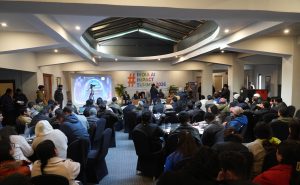
The Lt. Governor was speaking during the Pre-Artificial Intelligence Impact Summit 2026 organised by IT Department, UT Ladakh, here today.
Welcoming participants from across India, Shri Kavinder Gupta said that India is hosting the biggest AI Summit so far in New Delhi, under the visionary leadership of Prime Minister Shri Narendra Modi. The summit is bringing together renowned IT and technology leaders, innovators, and professionals from across the world, reflecting India’s emergence as a global hub for responsible, human-centric AI.
Shri Kavinder Gupta highlighted the summit as a critical platform to align Ladakh’s strategy with the upcoming National AI Summit and the vision of Digital India and the India AI Mission under the leadership of Prime Minister Shri Narendra Modi. He noted that the summit reflects a collective effort to use AI for inclusive growth and sustainable development, reinforcing Ladakh’s role in shaping India’s national AI agenda.
Shri Kavinder Gupta underlined that AI must remain people-centric, empowering citizens, strengthening government-public trust, and fostering inclusive growth. “Technology should serve people, not the other way around,” he said, emphasizing that AI solutions must focus on improving the lives of all sections of society.
Shri Kavinder Gupta outlined Artificial Intelligence as a practical solution for sustainable tourism, agriculture/animal husbandry, healthcare, education/skill development, energy/water management, disaster management, infrastructure, governance, citizen services, and space/astronomy- enhancing quality of life and service reach. He also highlighted Ladakh’s unique position as a geographically remote yet strategically vital, environmentally fragile yet naturally and culturally rich, where traditional development models face limitations, but AI offers opportunities to transform challenges.
The Lt. Governor also highlighted the significant potential of AI to transform economic opportunities for Ladakh’s youth, who constitute nearly 60% of the population. AI, he explained, can drive innovation, skill development, entrepreneurship, and economic progress, overcoming the limitations of geographic remoteness. He pointed out that Ladakh’s cold climate offers a natural advantage for energy-efficient AI data centers, while the region’s vast renewable energy potential—including solar, hydro, geothermal, and hydrogen sources—could power advanced AI infrastructure with minimal carbon impact.
Shri Gupta emphasised that Ladakh’s governance framework, supported by strong road networks and aligned with national missions, is business- and innovation-friendly. However, he noted that high-speed data connectivity remains a priority to fully realize AI’s potential. He proposed the creation of an AI Centre of Excellence in Ladakh to develop tailored solutions, establish data standards, and serve as a global model for high-altitude and border regions.
Concluding his address, Shri Kavinder Gupta called for collaboration among government, industry, academia, and civil society, urging Ladakh to emerge not just as a consumer of technology but as a creator of AI solutions that enhance governance, empower citizens, and preserve the region’s unique cultural and environmental heritage. “Ladakh’s future will not shape itself; together, starting today, we will build it,” he affirmed.
Earlier, the Lt Governor launched e-Seva Model and Village Assessment Module portals for efficient, transparent government services and accessible governance.
Chief Secretary Shri Ashish Kundra credited the Lt Governor’s initiative, noting PM Modi’s declaration that AI is “writing the code for humanity in this century,” paradigm shift from computing-based intelligence assessment, perils of excessive AI usage diminishing thinking abilities and impacting jobs, need for natural-artificial intelligence balance, and youth opportunity to learn AI skills turning adversity into advantage.
Administrative Secretary, IT, Smt Shashanka Ala described the Summit as prelude to New Delhi’s main AI Impact Summit, briefing sessions on AI in Governance, Transforming Education through AI, Innovation Infrastructure, Leveraging AI for Accessible/Efficient Healthcare, full-stack sovereign AI including tourism applications, talks by Rigo Mind and Acres of Ice. She highlighted key takeaways, required institutional mechanisms, background rationale, three flagship pillars (government processes re-engineering, climate resilience green platform, inclusive edge AI solutions), implementation roadmap, and expected 2026 outcomes.
NIC Consultant Shri Rigzin Namgyal delivered vote of thanks.
Among those present during the event were DGP Ladakh Shri Mukesh Singh, Vice-Chancellor of the University of Ladakh Prof Saket Kushwaha, Directors/Head of Departments, senior government officials, students, and speakers from different parts of the country.